Blog Culture@Work
Welcome! My name is Joost Thissen and here I like to share cultural columns and insights for those of us who are interested in culturally diverse and global workplaces.


Welcome! My name is Joost Thissen and here I like to share cultural columns and insights for those of us who are interested in culturally diverse and global workplaces.

 by Joost Thissen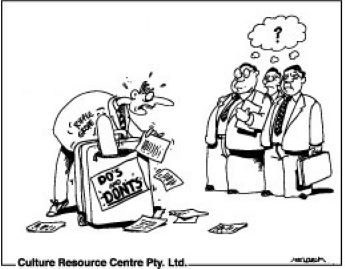
cultural column  Email This Post
An Australian manager prepared himself by memorising his substantial list of “Do’s and Don’ts at work” for each of the countries he was going to visit during his two-week Asian business trip. He was meeting with a project team in Shanghai, starting negotiations for a new subsidiary in Bombay, and he was going to be introduced to a possible business partner in Tokyo.
He prepared for what he thought to be the most important ‘Do’ applying to China: “The Chinese consider it is important to establish contacts before investing in a trip”; he had called ahead to a number of his team members about his arrival. For India he had prepared a list of questions to counter-attack the Indian ‘Don’t’: “If you are part of a negotiating team in India, be aware that a ‘Yes’, might not mean Yes”. He didn’t quite yet know how to tackle the concept of ‘saving face’, which he knew was very important in Japan, but decided to be very sensitive in his use of language.
All in all he was not too worried as he felt he was prepared and had things under control. Besides, isn’t it always important to establish prior contacts wherever you intend to do business, and not only in China? Isn’t it critical to ask the right questions wherever you go during any negotiation around the world, not only in India? And, don’t we all loath being embarrassed in meetings, not only in Japan?
Upon arrival in China there was nobody to welcome him at the airport, nor was he expected at the office. He found out later that he had not informed the appropriate people in the hierarchy of the project team; instead he had spoken to those people he was comfortable with (those whose accent he could best understand). Unintentionally he had shown disrespect for people in power positions and it took quite a while to re-establish his contacts. He misunderstood that ‘establishing contacts’ is far more complex and requires the right people at the right hierarchical levels.
In India he wasn’t even able to use his extensive list of questions as the negotiations only started at the last day as he was due to leave for Tokyo. After days of back-to-back meetings and activities with seemingly irrelevant partners, clients and governmental people in order to negotiate the conditions of the new subsidiary, he was exasperated. It was taking him so much time and could hardly keep track of the requirements of all the parties in the Indian negotiation team. Apparently, negotiations in India are not only about what is being said but also the complete process: who are involved and the multiple actions leading up to the negotiations.
Finally, when he landed in Tokyo – tired from the stress caused in Shanghai and Bombay – his trip was showing signs of a disaster. However, the Japanese welcomed him at the airport, wined and dined him over the weekend, and he played golf with the CEO of the future partner organisation. It was only then that the Australian began to relax. Although he was not a great consumer of ‘Sake’, nor was he a fan of raw fish, and was forced to order ‘steak the Australian way’ a number of times, he did produce his best score ever on the golf course and beat the Japanese CEO! Everybody congratulated him and smiled ever so friendly. He showed them that he was a genuine and tough competitor; the perfect set up for a partnership! The Australian manager had redeemed himself, or so he thought…
When the Australian manager arrived back at the Sydney office, his manager asked him what on earth had happened… The Chinese had asked for a new contact person, preferably with Chinese experience; The Indians had negotiated the best contract ever – for themselves! – and the Japanese had called off the partnership all together.
Only much later the Australian manager found out via a Japanese colleague that his task oriented ways of building trust had cost him dearly in Japan: he had caused loss of face by not consuming a drop of alcohol, not eating the exquisite local food and much worse, he had not given appropriate face to the CEO who was known to be a very bad golfer… he failed to understand the relationship oriented way of building trust which is invaluable in Japan.
Thinking that insights into cultural differences can be summarised as a magic list of “Do’s and Don’ts at work” can cost you business and your integrity – often without your knowledge. Behavioural differences between cultures are often subtle but can have major consequences for business relationships.
Professionals who apply critical thinking skills and invest in exploring underlying drivers to cultural behaviour will ask themselves: ‘why do culturally diverse people behave in a certain way, and can prepare themselves better. They focus on building a much broader knowledge (i.e. by mapping values and practices to understand the impact of culture on behaviour), they practice ways to adapt to cultural differences (i.e. by bridging skills to communicate the differences), and develop intercultural competencies to overcome the cultural barriers (i.e. by integrating strategies and intercultural competence to close the gaps). Ultimately, they will will have the leading edge.
_________________________________________
Joost Thissen, Partner & Interculturalist
joost@cultureresourcecentre.com.au
cultural column Email This Post